Founded by Richard Orilla, Orilla Technologies is a specialized software laboratory focused on high-level problem solving

We bridge the gap between low-level performance engineering and modern AI automation. Whether developing the Zero Engine or fine-tuning Gemini-first LLM pipelines, we provide technical solutions built on deep research and engineering rigor.

Engineering the Core. Automating the Future.

High-performance systems engineering, specialized AI integration, and robust software architecture designed to solve complex technical challenges.

Context Aware Unstructured Data Extraction

  • The Challenge: A logistics client faced a backlog of thousands of unstructured invoices and shipping manifests in various formats (scanned PDF, images, Excel). Manual entry was error-prone and slow. Traditional OCR failed to capture the semantic relationships between table rows and headers.
  • The Technical Solution: Orilla Technologies engineered a multi-modal pipeline using Docling for advanced layout analysis. Unlike standard text extraction, our pipeline understood the visual structure of the document, identifying multi-column layouts and nested tables. We integrated a Gemini-Pro vision model to handle edge cases where OCR failed, creating a robust 'fallback' mechanism.
  • The Architecture:
    • Ingestion: Raw files uploaded to Azure Blob Storage.
    • Preprocessing: Image enhancement and orientation correction.
    • Extraction: Parallel processing using Docling to convert PDF to Markdown/JSON.
    • Semantic Parsing: An LLM agent mapped the raw text to a structured JSON schema (InvoiceID, Date, LineItems).
    • Validation: A 'Human-in-the-Loop' UI flagged low-confidence extractions for review.
  • The Outcome: Reduced manual processing time by 50%. Improved data accuracy to 99.8%. The system now scales to process 10,000 documents per hour with a 'Local-First' processing model that ensures data privacy.

We perform a rigorous audit of your core technical requirements and existing stack.


Self-Healing Web Automation

  • The Challenge: A client needed to aggregate real-time pricing data from competitor sites. However, these sites frequently changed their DOM structure (CSS selectors), constantly breaking traditional scrapers and requiring high maintenance overhead.
  • The Technical Solution: We architected a 'Self-Healing Strategy/Spider' system. Instead of hardcoding selectors, we used a two-stage process.
  • The Architecture:
    • Strategy Generator: An AI Agent (powered by browser-use) navigates the site once to 'learn' the layout and generates a deterministic JSON plan (The Strategy).
    • Spider Executor: Lightweight, fast Playwright scripts execute the JSON plan for mass data extraction.
    • Self-Healing Loop: If a spider fails, the context (HTML/Screenshot) is sent back to the AI Agent, which analyzes the break, patches the selector, and updates the Strategy JSON automatically.
  • The Outcome: Achieved 99.9% uptime on scraping operations. Drastically reduced API costs by only using expensive LLMs for 'planning' and cheap scripts for 'execution.' The system effectively 'fixes itself' when websites change.
Connect, Innovate, Succeed

Connect, innovate, succeed

Engineering is a craft that requires both logic and creativity. At Orilla Technologies, we bring a "3 quarts geek, 1 quart musician" perspective to every project. We are ready to help you navigate uncharted technical waters.

From Linux kernel optimization to Agentic AI workflows. Let's build the invisible architecture of your next big success.
Visual Logic Mapping (Angebot 3.0)

  • The Challenge: The client needed a system where sales staff could create complex, dynamic quotes ('Angebots') with conditional logic—e.g., 'If client is in EU, apply VAT; if volume > 1000, apply 5% discount.' Hardcoding these rules made the system inflexible and dependent on developers for every pricing change.
  • The Technical Solution: We implemented Visual Logic Mapping. Instead of writing code for every rule, we integrated Rete.js on the frontend (Angular) to allow non-technical administrators to build logic flows visually using nodes and wires. This visual graph was then serialized into JSON and interpreted by a Python/Linux backend execution engine.
  • The Architecture:
    • Frontend: Angular 2 application with a custom Rete.js node editor.
    • Backend: A Python execution engine that interpreted the JSON logic graph.
    • State Machine: A rigorous state machine managed the quote lifecycle (Draft -> Sent -> Viewed -> Approved -> Archived).
  • The Outcome: Empowered the sales team to modify pricing logic without developer intervention. Reduced 'logic change' support tickets by 90% and enabled rapid iteration of pricing strategies.
AI Orchestration Case Study

Months of Engineering. Compressed into Days.

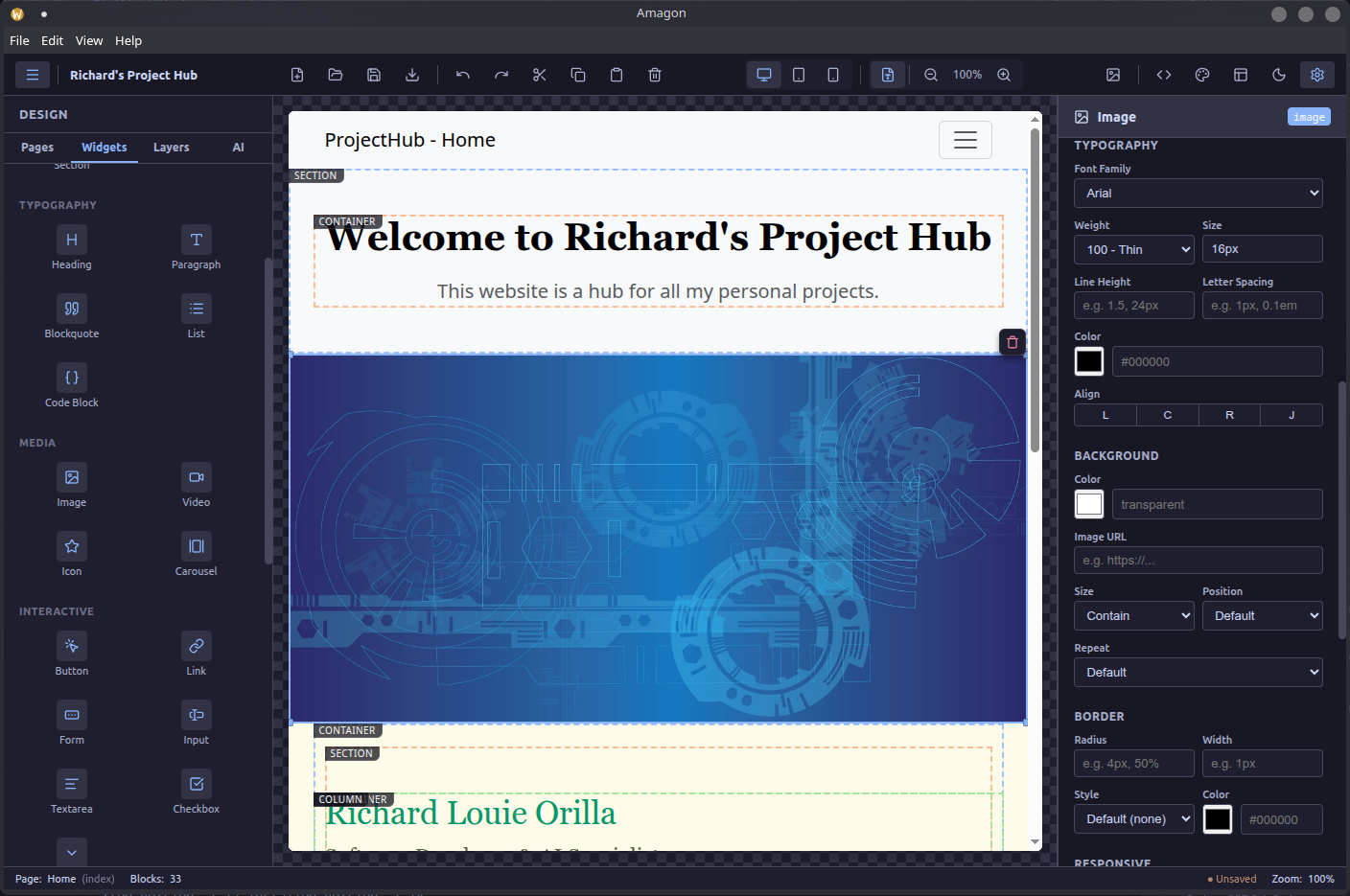
Amagon is a flagship project of the Orilla AI Lab, proving that complex desktop software—traditionally requiring months of solo development—can be built in under 100 hours using a Rigorous Multi-Agent Vibe Coding Workflow.

4 Days
Development time
vs
5 Months
Traditional Estimate

Agent Specialization Stack

🏢 The Architect (Claude Opus 4.6)

Led the 12-phase master plan. Handled Electron IPC, global state management (Zustand), and system-wide file I/O coherence.

⚙️ The Engine Specialist (GPT 5.2 HT)

Engineered the iframe-isolated canvas, coordinate mapping for cross-iframe DnD, and complex AST parsing for bidirectional sync.

🎨 The UI Craftsman (Gemini 3 Pro)

Batch-generated 50+ component widget schemas and constructed the dynamic property inspector using glassmorphic UI patterns.

🧪 The Quality & UX Specialist (Kimi K2)

Fine-tuned accessibility, keyboard shortcuts, and conducted the deep-dive revision phases to eliminate edge-case bugs.

The Vibe Coding Workflow

1
Planning Phase

One 'Meta-Planner' AI analyzes the research doc and produces a granular 12-phase plan.md.

2
Agent Handover

Specific agents are 'Vibed' (switched) based on phase requirements to tackle specialized code blocks.

3
Human-Centric Audit

Developer acts as 'Director', reviewing AI output at each checkpoint to ensure architectural integrity.